

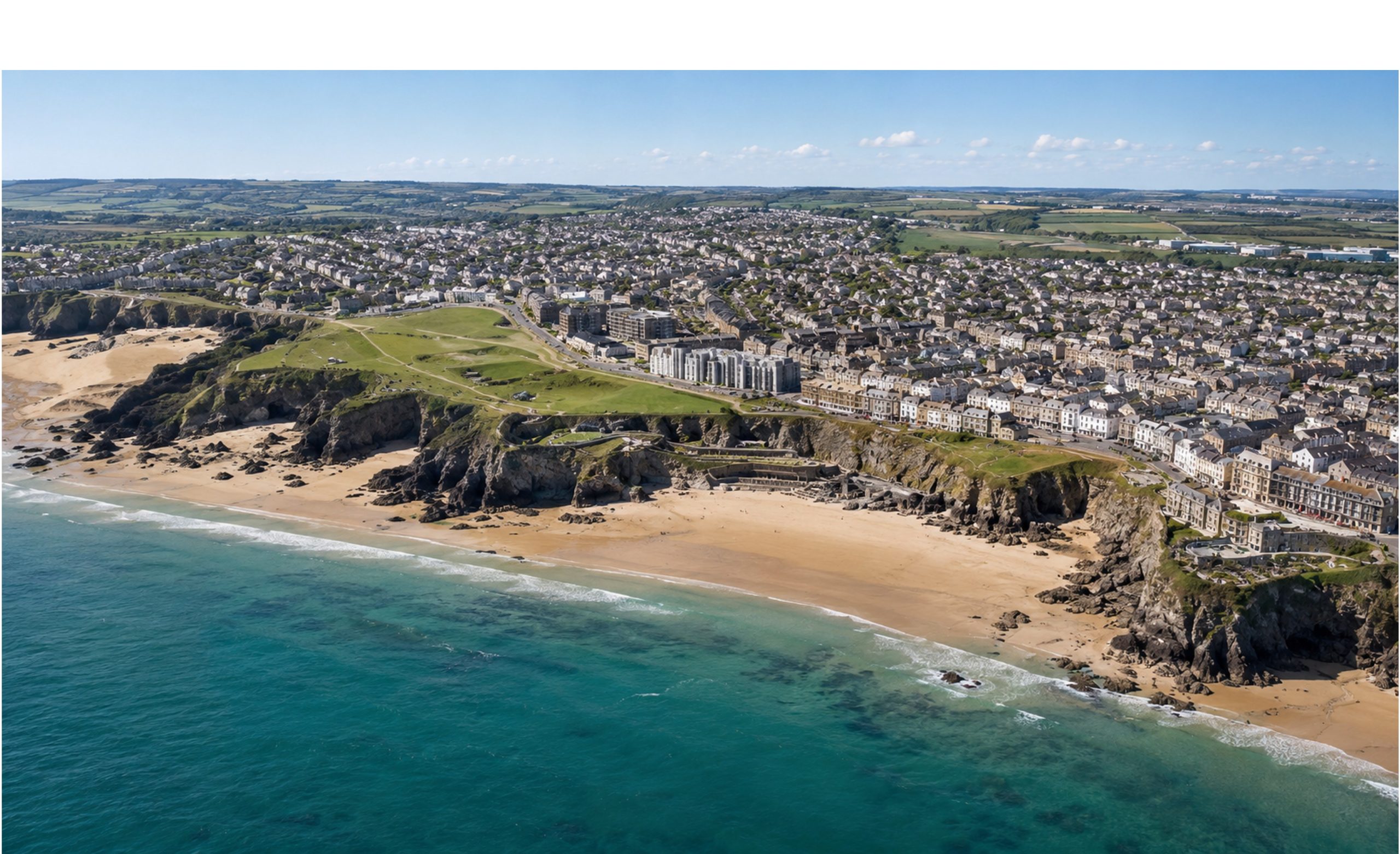
Narrowcliff is a proposed residential development overlooking the Atlantic coast in Newquay. Its setting is spectacular. From a wind perspective, it is also exceptionally difficult. ArcAero’s assessment found large areas of strong wind occurrence across parts of the existing site and surrounding area before the proposed development was introduced. That creates a difficult question for designers, wind engineers and planning authorities: what can reasonably be expected from a new development where the existing environment already fails the commonly applied criterion?
Exposed to the Atlantic
The first challenge is the regional wind climate. Narrowcliff faces the Atlantic Ocean, with very little upstream shelter from prevailing westerly and north-westerly winds. These winds can travel across the water without the friction and disruption created by buildings, trees and other land-based obstructions. The site therefore receives strong winds more frequently than a typical inland development. So even before the local topography and buildings are considered, it begins from a demanding baseline.

The Cliffs Make It Worse
The site sits immediately behind the steep cliffs above Tolcarne Beach. CFD streamlines show winds approaching from the sea being forced up the cliff face and accelerating over the crest, before sweeping across the road towards the development site. Some of the strongest acceleration occurs before the flow has interacted with the buildings at all. This topographical effect is fundamental to the site.

An Already Difficult Baseline
The Lawson criterion identifies locations where strong winds could destabilise pedestrians. At Narrowcliff, CFD simulations of the existing site predicted substantial regions of strong wind around the clifftops and nearby streets. A new development must minimise deterioration, protect key entrances and routes, and provide reasonable mitigation where conditions worsen. Against such a severe baseline, mitigation can reduce exceedances in some areas, but removing them entirely is not realistic. An assessment based solely on absolute compliance would therefore overlook whether the development has improved, maintained or worsened conditions relative to the existing baseline.

Measuring The Change
ArcAero divided the site and surrounding area into zones, then compared the worst result in each zone between the existing and proposed conditions. With mitigation in place, eight of the eleven surrounding zones improved, albeit only marginally in places, two were unchanged and one became slightly windier. Within the development site, some local strong-wind areas remained. This comparison matters because many strong-wind areas were already present. The assessment therefore considered whether the development improved, maintained or worsened conditions, rather than only whether every location met the criterion.

A Better Measure?
Narrowcliff is an extreme example, but the issue is unlikely to remain confined to exposed coastal sites. Cities such as Manchester, Leeds and Glasgow combine relatively strong regional wind climates with increasing building height and continually changing surroundings. In some locations, existing buildings and public routes may already experience problematic conditions before the next development is introduced. The Lawson criteria provide a valuable benchmark. A valid question is how that benchmark should be applied where complete compliance may be physically unrealistic. If a development improves an already difficult wind environment, addresses the deterioration it creates and provides sensible conditions for its entrances, routes and amenity spaces, should some remaining inherited exceedances outweigh the improvement achieved? Narrowcliff suggests that the answer needs more thought.